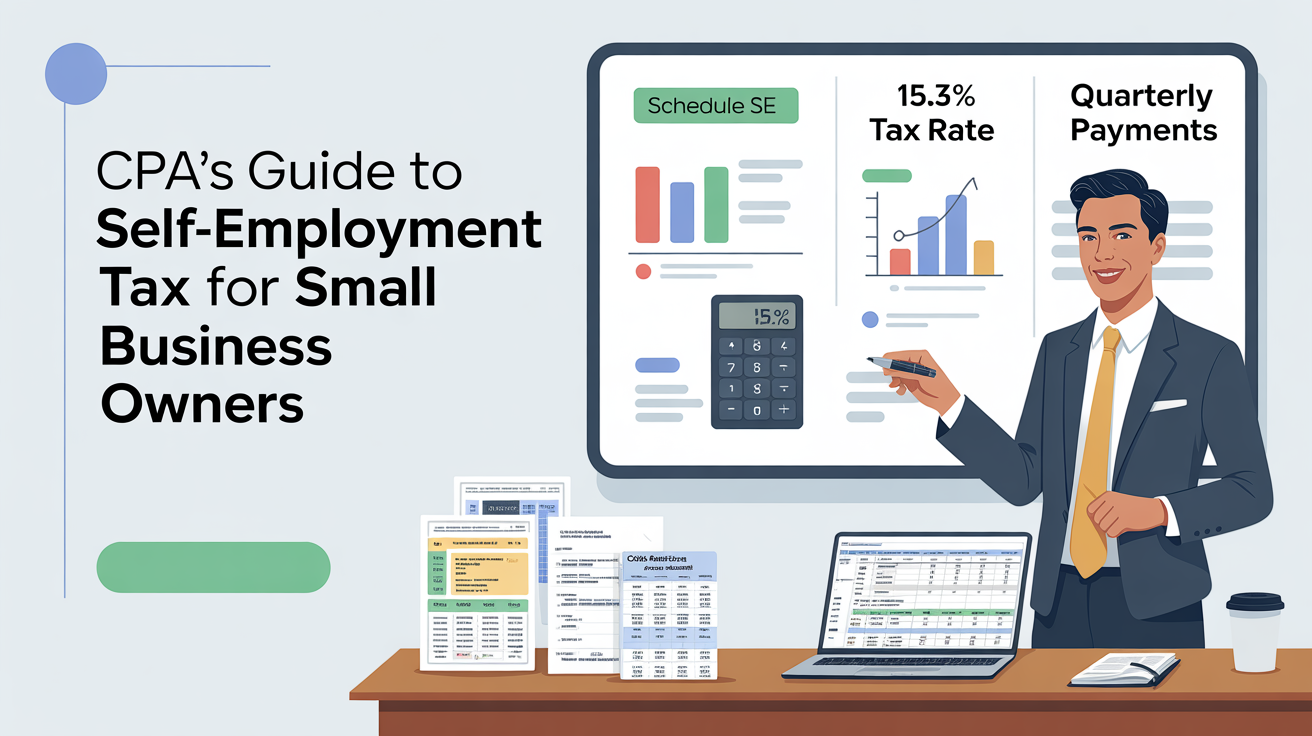

As a small business owner, you likely handle many tasks on your own. However, understanding self-employment tax can feel tricky at first. Therefore, this guide, written from a CPA’s view, explains it in simple terms. Additionally, it helps you stay compliant and save money where possible.
Self-employment tax covers Social Security and Medicare for people who work for themselves. In contrast to employees, who split these costs with their bosses, self-employed folks pay the full amount. So, knowing the basics is key to avoiding surprises.
What Is Self-Employment Tax?
Self-employment tax is a way for business owners to fund retirement and health programs. Specifically, it includes 12.4% for Social Security and 2.9% for Medicare, totaling 15.3%. But, you only pay on 92.35% of your net profits after deductions.
Moreover, if your net earnings top $400 in a year, you must pay this tax. For example, freelancers, shop owners, or consultants often face it. Meanwhile, regular employees do not, because their employers handle half.
Who Needs to Pay Self-Employment Tax?
First, check if you qualify as self-employed. Generally, if you run a business alone or as a partner, you do. Even part-time gigs count. However, church workers or some ministers might get exemptions.
Next, gather your income details. Importantly, net earnings mean profits minus business costs like supplies or ads. Thus, accurate records help lower what you owe.
How to Calculate Self-Employment Tax
Calculating is straightforward with the right steps. Initially, find your net profit from Schedule C on your tax form. Then, multiply by 92.35% to get the taxable amount.
After that, apply the 15.3% rate. For instance, on $50,000 net earnings, you might owe around $7,065. Fortunately, you can deduct half of this tax from your income, reducing your overall bill.
Step-by-Step Calculation Guide
Start by listing all business income. Subtract expenses to find net profit. Now, adjust for the 92.35% factor. Finally, add any extra Medicare tax if earnings exceed $200,000 for singles.
Furthermore, use IRS Schedule SE to do this easily. Tools like tax software simplify it too.
Tips to Lower Your Self-Employment Tax
You can cut your tax with smart moves. For one, track all deductions, such as home office costs or vehicle use. Also, consider retirement plans like SEP-IRA, which reduce taxable income.
In addition, health insurance premiums are often deductible. Consequently, these steps not only lower taxes but also build your future security.
Common Deductions for Small Businesses
Home office space qualifies if used only for work. Travel and meals for business are partial deductions. Supplies and software count fully. Therefore, keep receipts organized.
Filing and Paying Self-Employment Tax
File with your annual 1040 form by April 15. If you expect to owe over $1,000, make quarterly payments. Otherwise, penalties add up.
Besides, use IRS tools or a CPA for help. This ensures accuracy and peace of mind.
Avoiding Common Mistakes
Do not forget quarterly estimates. Also, avoid mixing personal and business expenses. Instead, separate accounts. Moreover, update records often to spot issues early.
In summary, self-employment tax is manageable with knowledge and planning. By following these tips, you can focus more on growing your business. Overall, consult a CPA for personalized advice, as rules may change.