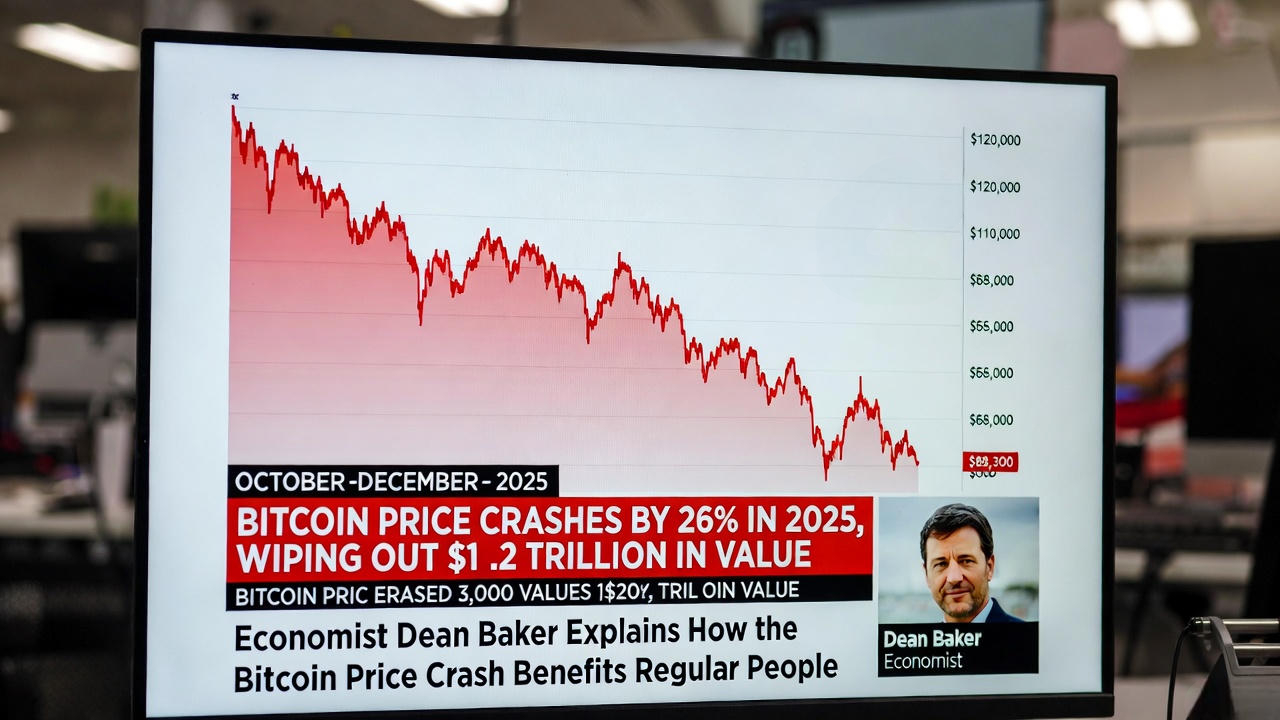

- Research suggests that a Bitcoin crash might ease economic pressures for ordinary folks, as argued by some economists.
- It seems likely that reducing “fake” demand from crypto could lower prices for everyday items like homes and tickets.
- However, the evidence leans toward mixed impacts, with benefits for non-crypto holders but losses for investors; this topic sparks debate among experts.
What the Economist Says
Dean Baker, an economist at the Center for Economic and Policy Research, recently shared his view. He compares Bitcoin and other cryptocurrencies to counterfeit money. In simple terms, when people use crypto to buy things, it drives up prices. But if crypto values drop, that extra demand goes away. As a result, regular people might find houses or event tickets more affordable.
Recent Bitcoin Trends
Bitcoin hit a high of over $120,000 in October 2025 but fell to around $88,300 by December. This crash wiped out about $1.2 trillion in market value. While investors suffer, Baker says this shift puts more buying power back into the hands of everyday people.
Broader Implications
Overall, the idea highlights how crypto’s ups and downs affect the real economy. Yet, not everyone agrees, as some see crypto as a valuable innovation.
In today’s fast-changing financial world, Bitcoin’s recent tumble has sparked much discussion. For instance, many wonder if this crash is bad news for everyone. However, according to economist Dean Baker, it could actually help regular people in surprising ways. Let’s explore this idea step by step.
Understanding the Bitcoin Crash
First, Bitcoin soared to new heights earlier this year. In October 2025, it reached over $120,000 per coin. But then, prices started to fall sharply. By mid-December, Bitcoin was trading at about $88,300. Moreover, this drop erased around $1.2 trillion from the crypto market’s total value. As a result, many investors felt the pain. Nevertheless, Baker sees a silver lining for those not involved in crypto.
To illustrate, here’s a simple chart showing Bitcoin’s price changes in 2025:

Why a Crash Might Help Everyday Folks
Baker, co-director at the Center for Economic and Policy Research, explains it clearly. He says cryptocurrencies act like fake bills in the economy. For example, when shady groups use crypto to buy scarce items, prices go up for everyone. Housing costs rise, and even Super Bowl tickets become pricier. Therefore, a crash removes this “fake money” from circulation. Consequently, demand drops, and prices could fall back down.
Furthermore, Baker notes that crypto has no real-world value. It’s built on thin air, he argues. So, when its worth shrinks, regular people gain more purchasing power. In other words, there’s more for everyone else. Additionally, the only downside is less crypto being made, which Baker jokingly calls a “horror.”
But wait, is this view shared widely? Some experts disagree. For instance, others point out that crypto crashes can hurt jobs in tech or mining. Still, Baker focuses on the big picture. He compares it to spotting counterfeit cash and pulling it out. This benefits the public by easing economic strain.
Economic Impacts of the Crash
Moving on, the broader economy feels these shifts too. Over the past year, crypto boomed, adding fake demand. Now, with prices down, that pressure eases. Housing markets might cool, making homes more reachable for families. Similarly, event tickets could become cheaper.
However, not all effects are positive. Investors lose money, and some businesses suffer. Yet, for non-owners, it’s like getting a boost. Baker estimates the $1.2 trillion loss equals sending $10,000 to each U.S. household – in terms of freed-up value.
To put this in perspective, here’s a table comparing Bitcoin’s performance:
| Period | High Price | Low Price | Market Impact |
|---|---|---|---|
| October 2025 | $120,000+ | N/A | Peak hype and investment |
| December 2025 | N/A | $88,300 | $1.2 trillion value loss |
| Year-over-Year | Up 12% | Down now | Benefits non-investors |
Besides, other economists have weighed in. For example, in older crashes like 2022, experts said crypto drops wouldn’t wreck the whole economy. Today, with Bitcoin more mainstream, the story is similar. But Baker’s take adds a twist: it might actively help average people.
In addition, global views matter. Around the world, many see crypto as risky. Therefore, a crash could stabilize markets everywhere. Nevertheless, supporters argue Bitcoin builds wealth for the future.
Looking Ahead
Finally, what does this mean for you? If you’re not in crypto, cheer the dip, says Baker. It could make life cheaper. But if you own some, watch closely. Overall, this debate shows how digital money ties into real lives.
In conclusion, while Bitcoin’s crash hurts some, it might benefit many more. As Baker puts it, it’s about sharing the economy fairly.
Key Citations: