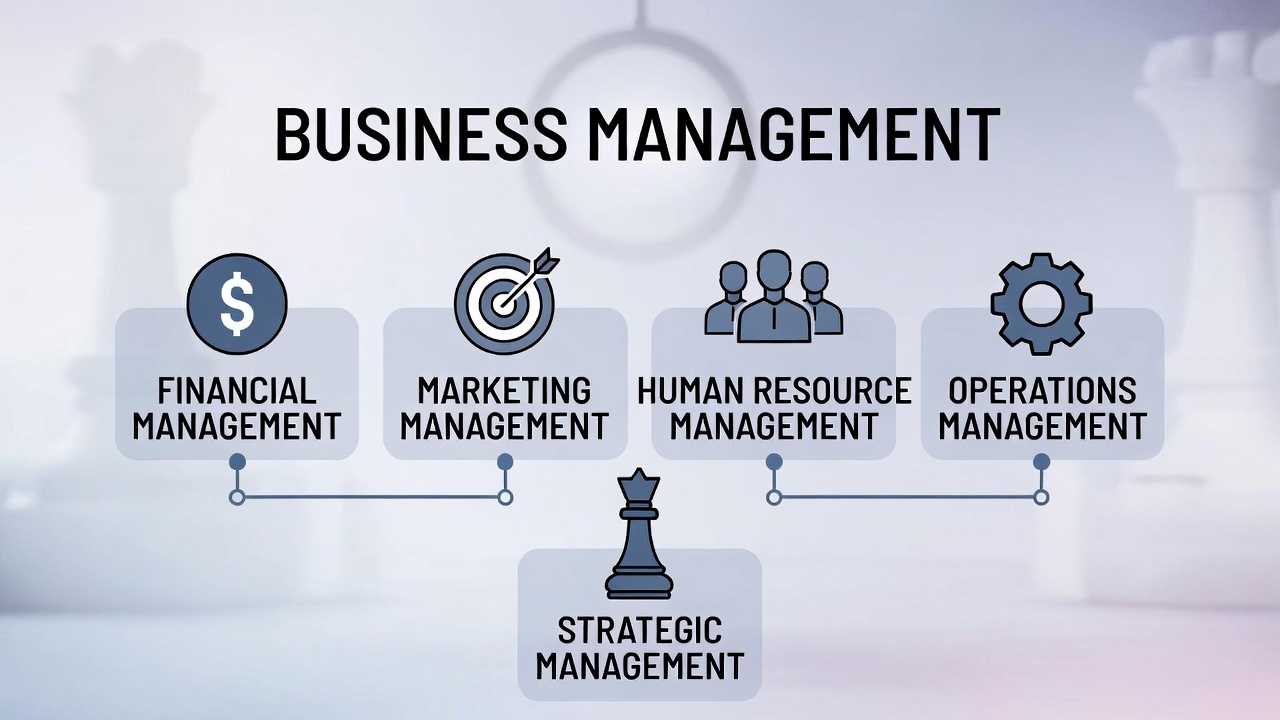

Business management is a broad field that helps companies operate effectively. In fact, it covers various areas, each with its own focus. However, these branches often connect to support the whole organization. First, let’s explore the core ones in detail. Moreover, we’ll use simple words to make it easy to understand. Additionally, transition words will guide you through the ideas smoothly.
Financial Management: Handling Money Wisely
To begin with, financial management is about managing funds. It includes creating budgets, monitoring expenses, and investing wisely. For example, managers in this branch ensure there’s enough cash for daily needs. Furthermore, they analyze risks to avoid losses. Therefore, this branch is crucial for keeping the business stable. However, without good financial control, companies can face big problems. In addition, it involves decisions on loans and profits. As a result, strong financial management leads to growth and success.
Marketing Management: Promoting Products and Services
Next, marketing management focuses on reaching customers. It starts with understanding what people want. Then, it develops strategies for advertising and pricing. Moreover, this branch handles brand image and competitor analysis. Additionally, it uses tools like social media to build loyalty. However, in a changing market, adaptability is key. Therefore, effective marketing boosts sales and visibility. For instance, successful campaigns can turn a small business into a big name. Consequently, it drives revenue and customer satisfaction.
Human Resource Management: Caring for People
Furthermore, human resource management deals with employees. It involves recruiting the right talent and providing training. Also, it manages benefits, safety, and motivation. In addition, this branch resolves conflicts and promotes a positive culture. However, engaged workers perform better. Therefore, HR helps retain staff and reduce turnover. For example, good policies can improve job satisfaction worldwide. As a result, it supports innovation and productivity across the company.
Operations Management: Streamlining Processes
Moreover, operations management ensures smooth daily work. It oversees production, supply chains, and quality control. First, it designs efficient workflows. Then, it monitors resources to cut waste. Additionally, this branch uses technology for better output. However, challenges like delays can arise. Therefore, quick fixes are essential. For instance, in manufacturing, it turns raw materials into products fast. Consequently, it lowers costs and meets customer demands effectively.
Strategic Management: Planning for the Future
Also, strategic management sets long-term directions. It analyzes strengths, weaknesses, and opportunities. Furthermore, it creates plans to achieve goals. In addition, this branch coordinates with others for unity. However, external changes like market shifts require flexibility. Therefore, regular reviews keep strategies relevant. For example, during crises, it helps businesses adapt. As a result, it ensures sustained success and competitiveness.
Other Important Branches
Besides these, there are more branches like project management, which handles specific tasks. Additionally, innovation management fosters new ideas. Moreover, environmental management focuses on sustainability. However, these build on the main ones. Therefore, together they form a complete management system.
A Quick Comparison Table
| Branch | Key Focus | Main Tasks |
|---|---|---|
| Financial | Money handling | Budgeting, investing, risk assessment |
| Marketing | Customer outreach | Advertising, pricing, brand building |
| HR | Employee care | Hiring, training, motivation |
| Operations | Daily efficiency | Production, supply chain, quality control |
| Strategic | Long-term planning | Goal setting, analysis, adaptation |
This table shows how each branch contributes uniquely but connects overall.
These branches make business management comprehensive. However, their importance varies by company type. Therefore, learning them can help in any career. Moreover, as the world changes, new branches may emerge. Additionally, global readers appreciate this clear approach. Finally, always integrate them for best results.